
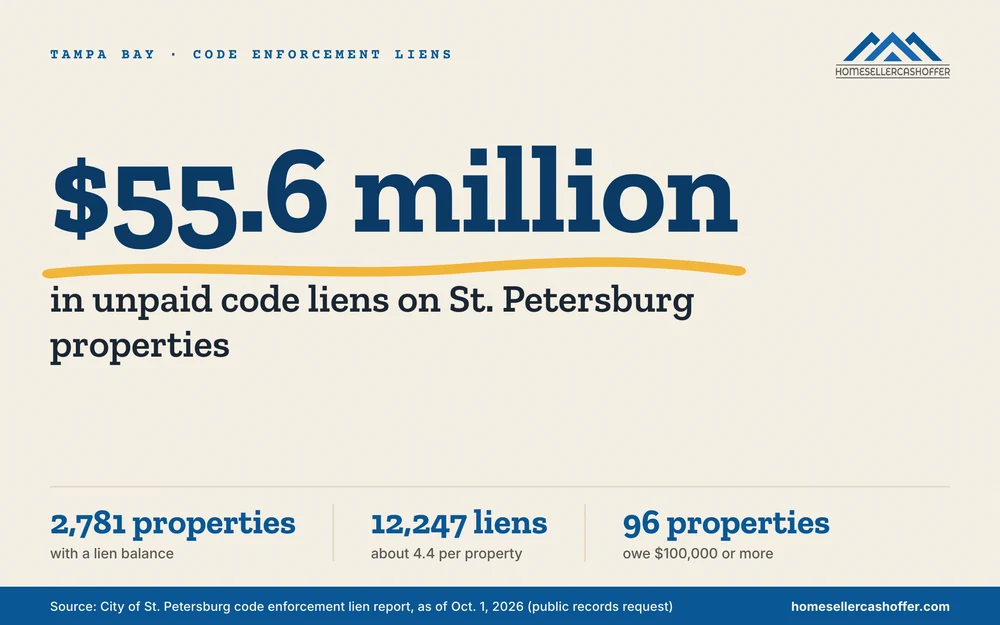
St. Petersburg: 12,247 liens on 2,781 properties
| Measure | City’s report, Oct 1, 2026 |
|---|---|
| Unpaid liens | 12,247 |
| Properties with a balance | 2,781 |
| Total owed | $55.6 million |
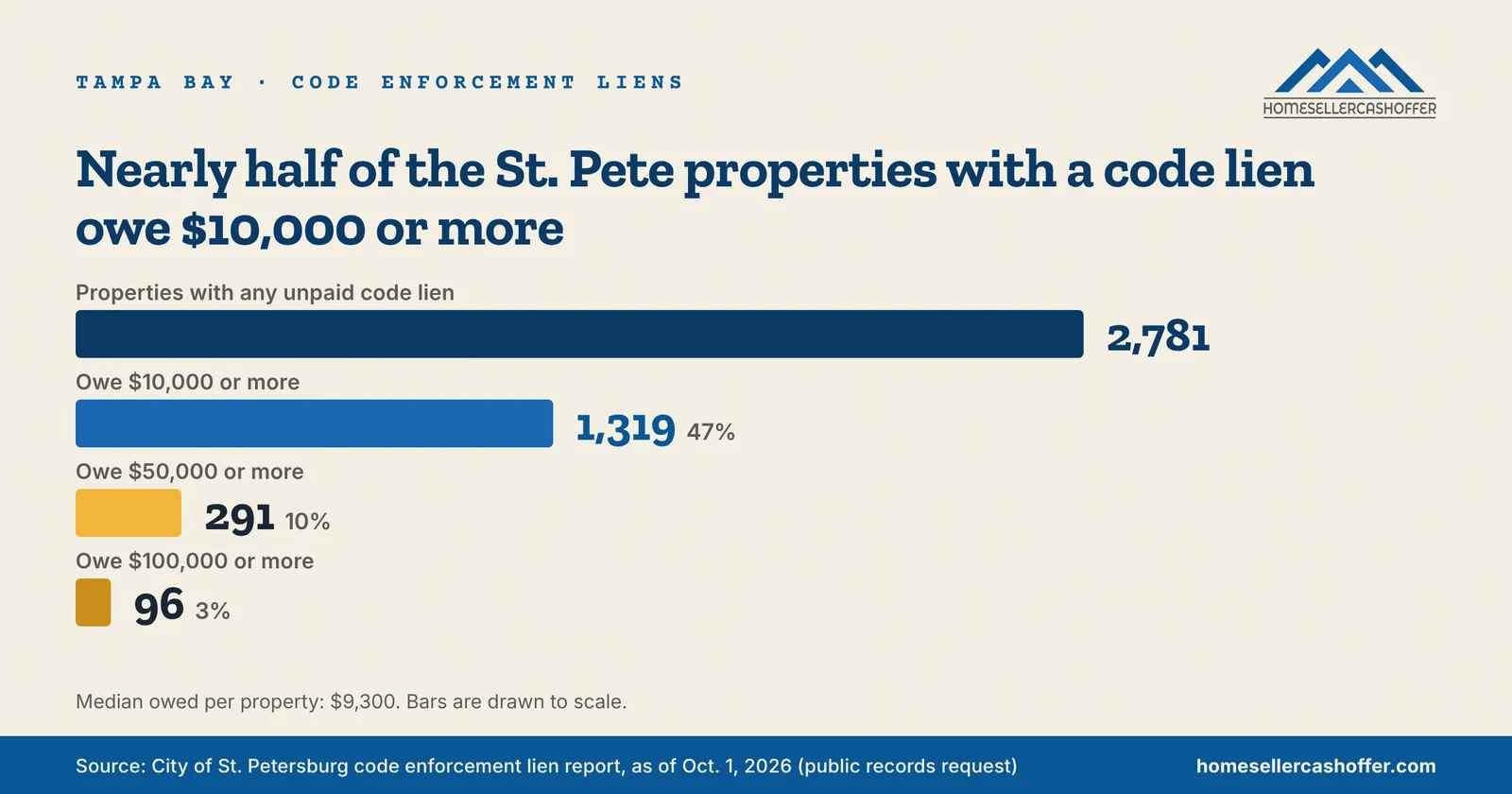
| Median owed per property | $9,300 |
| Properties owing $10,000 or more | 1,319 (47%) |
| Properties owing $50,000 or more | 291 (10%) |
| Properties owing $100,000 or more | 96 |
Two things stand out.
One case, many liens. That is 4.4 liens per property on average. In the City’s report, many cases show a new lien recorded month after month while a Code Enforcement Board order goes unmet. The balance keeps growing until the property complies.
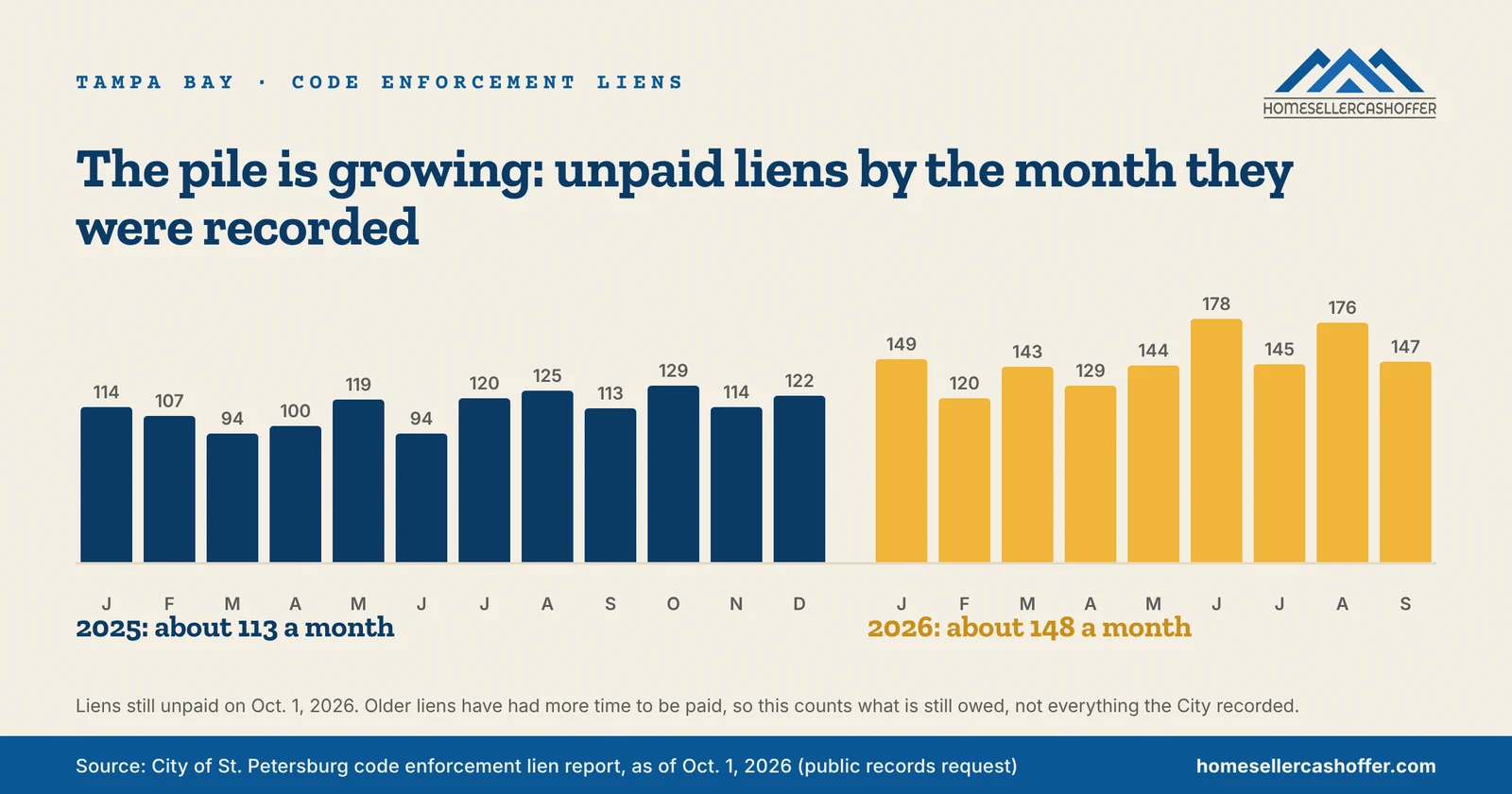
The pile is growing. Of the liens still unpaid on October 1, about 148 a month were recorded in 2026, compared with about 113 a month in 2025. Older liens have had more time to be paid, so this is a count of what is still owed, not of everything the City recorded.
Clearwater: fewer properties, much bigger balances
Clearwater’s lien report, as of October 12, 2026, shows $31.8 million due on code enforcement liens on just 126 properties. That is about $252,000 per property on average. Across all of the city’s lien types, 53 properties owed $100,000 or more.
Tampa: 12,792 open records
Tampa’s list, as of October 12, 2026, held 12,792 open code enforcement records on 7,452 properties. Most are complaints. The city’s file has no lien amounts, so there is no dollar total to report.
Each city keeps different records, so compare within a city, not across cities. The full tables for all eight cities are on our code enforcement liens data page.
How a fine becomes a lien
Florida Statutes §162.09 sets the rules:
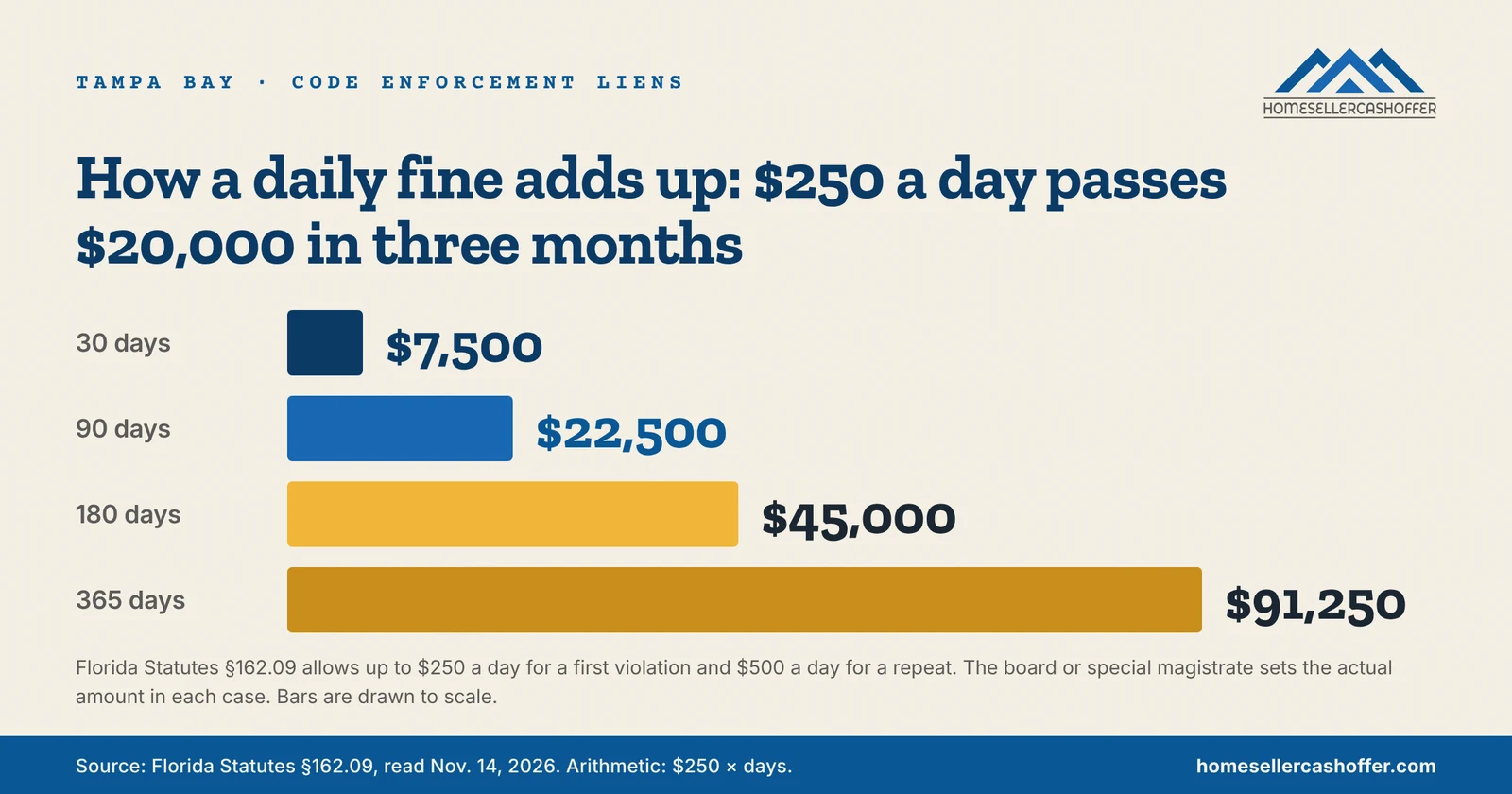
- Daily fines. A code enforcement board or special magistrate can fine an owner for every day a violation continues past the deadline: up to $250 a day for a first violation and $500 a day for a repeat. Cities and counties with 50,000 or more residents can adopt higher caps, up to $1,000 and $5,000 a day.
- It adds up fast. At $250 a day, 90 days is $22,500.
- The order becomes a lien once a certified copy is recorded in the public records. The statute says it attaches to the land where the violation is and to any other real or personal property the violator owns.
- Homestead. A code lien cannot be foreclosed on a homestead. On other property, the board can authorize foreclosure once a lien has gone unpaid for three months.
- It lasts. Under §162.10, a code lien can run for up to 20 years.
What an owner can do
1. Show up before the lien is certified. In St. Petersburg, if you miss the board’s compliance date, a Special Magistrate holds a lien certification hearing. The City describes that hearing as the owner’s chance to appear and ask for more time without penalty. The magistrate can defer the lien so you can fix the problem.
2. Fix it, then ask for a reduction. St. Petersburg’s Code Enforcement Board hears lien reduction and release requests on a notarized written application. The City’s rule: the board will not reduce or release liens on a property that still has active violations. So the order matters. Cure first, apply second. State law also lets an enforcement board reduce a fine it imposed.
3. Get the real payoff. Open cases are on the City’s Active Codes Cases Map, and Codes Compliance Assistance (727-893-7373) can give the history at an address. Payoff amounts come from a lien research request to the City’s Billing & Collections office. The City’s form asks for a company customer number and a file number, so in a sale it is normally the title company that files it. Fines run daily, so the payoff should be dated close to your closing.
4. Sell, and let the closing pay it. Recorded liens show up in the title search and are paid or released from the sale proceeds at closing. If the repair is more than you want to take on, an as-is buyer takes over the cure after closing. More: selling a St. Petersburg house with code violations or liens.
If you want a number on your house
We buy houses as-is in Pinellas, Hillsborough, Pasco and Manatee from our office at 433 Central Ave in downtown St. Petersburg. We buy many homes with our own cash; on some deals we partner with a vetted local investor, and we tell you upfront, in writing, before you sign. The lien payoffs we know about are shown in the offer math, and a licensed Florida title company settles them at closing. Call or text (727) 258-3540.
Common questions
How much is owed in code enforcement liens in St. Petersburg?
$55.6 million on 2,781 properties, according to the City’s code enforcement lien report as of October 1, 2026. The median property owed $9,300, and 96 properties owed $100,000 or more.
Can I sell a house that has a code lien in Florida?
Yes. Recorded code liens show up in the title search and are paid or released from the sale proceeds at closing. A buyer who buys as-is can take over the repairs after closing.
Can a code lien be foreclosed on my homestead?
No. Florida Statutes 162.09 says a code enforcement lien cannot be foreclosed on real property that is a homestead. On other property, the board can authorize foreclosure once a lien has gone unpaid for three months.
How long does a code enforcement lien last in Florida?
Up to 20 years. Florida Statutes 162.10 says no code enforcement lien continues for longer than 20 years.
Can St. Petersburg reduce a code lien?
The Code Enforcement Board hears lien reduction and release requests on a notarized application. It will not reduce or release liens on a property that still has active code violations.
Sources
- City of St. Petersburg code enforcement lien report as of October 1, 2026; City of Clearwater lien report and City of Tampa list of open code enforcement records as of October 12, 2026 (sent to us under Florida’s public records law; counts and totals only, no addresses, parcel numbers or owner names; full tables and a CSV on our data page)
- Florida Statutes 162.09, Administrative fines; costs of repair; liens (daily fine caps, when an order becomes a lien, homestead, foreclosure after three months, the board’s power to reduce a fine)
- Florida Statutes 162.10, Duration of lien (20 years)
- City of St. Petersburg, Codes Compliance Assistance (lien certification hearings, lien reduction and release, the Active Codes Cases Map, 727-893-7373)
- City of St. Petersburg Billing & Collections, Lien Research Request (what the payoff request asks for)
- Statutes and City pages read on November 14, 2026.
Not sure what is on your property?
Send the address and we’ll look up the open cases and the recorded liens with you — including “fix it and ask for a reduction” if that’s the answer.
Have a specific situation? Reach outThis article is general information about code enforcement liens in Tampa Bay. We are not attorneys or real estate agents, and it is not legal advice. If a foreclosure has been filed or the fines are disputed, talk to a Florida attorney first.

AL Cakici · Owner, HomeSellerCashOffer (Tampete Homes LLC)
AL is the owner and manager of Tampete Homes LLC (Florida LLC L25000252906, d/b/a HomeSellerCashOffer) and buys houses in Pinellas, Hillsborough, Pasco and Manatee, many with its own cash. He has personally purchased and assisted with 100+ real estate transactions since 2019 across the country. He is not an attorney or a real estate agent; this article is general information drawn from the official sources listed on this page, not legal advice. Facts checked against those sources on November 14, 2026.