
What actually happens when a tax bill goes unpaid
Property tax bills go out November 1. Pay in November and you get a 4% discount; the discount shrinks each month and disappears in March. On April 1 the unpaid bill becomes delinquent. Both counties add 3% interest on the spot, plus the cost of advertising your name and parcel in the newspaper once a week for three weeks in May.
Then the county stops waiting for you and gets its money from someone else. On or before June 1 the Tax Collector holds a tax certificate sale (Hillsborough runs it on the last Saturday of May; Pinellas runs it online on RealAuction). An investor pays your bill in exchange for a tax certificate: a first lien on your property that outranks even your mortgage. Investors bid the interest rate down from a maximum of 18%, but Florida guarantees them a minimum 5% return when you pay it off, however low the bid went.
Three things to understand about a certificate:
- You still own the house. Nothing has changed on title. You owe an investor instead of the county, and the debt is now earning interest.
- It is not a one-time event. Miss the next bill and another certificate is sold against the same house the following June. Many of the auctions we watch involve three or four years of stacked certificates.
- It has a seven-year life. A certificate holder who never acts within seven years loses their money. Almost none of them wait that long.
In Pinellas, payment must reach the Tax Collector by 4:30 p.m. the business day before the certificate sale to keep a certificate from being issued. After that, the number includes the investor's interest and fees, and it goes up every month.
The timeline, with the dates that matter
The clock on a Florida tax deed starts on April 1 of the year the certificate was sold, not on the day you missed the bill. Two years later, the certificate holder can file a tax deed application with the Tax Collector. That filing is the point where the house is in real danger.
Take a 2024 tax bill as the example:
- November 1, 2024: the bill arrives.
- April 1, 2025: it goes delinquent. 3% interest and advertising costs are added.
- By June 1, 2025: a tax certificate is sold on the house. Interest starts accruing to the investor.
- February 2027: the Pinellas Tax Collector mails a courtesy letter to owners whose property is in jeopardy of a tax deed application. Hillsborough's site does not describe a comparable letter; do not wait for one.
- April 1, 2027: the certificate holder may now file a tax deed application. To do it, they pay off every other certificate and all unpaid taxes on the house, so one filing captures every year you are behind. That whole amount then earns 1.5% a month until the sale.
- Roughly three to six months later: the Clerk of the Circuit Court orders a title search, sends a Notice of Application for Tax Deed by certified mail to the owner and every lienholder, advertises the sale for four consecutive weeks, and sets the date. Pinellas sells online at pinellas.realtaxdeed.com starting at 11:00 a.m.; Hillsborough sells most Thursdays at 10:00 a.m. at hillsborough.realtaxdeed.com.
- Sale day: the house goes to the highest bidder, and the Clerk issues a deed to the winner.
So a single missed bill can cost you the house in about two and a half to three years, and the last six months of that are the only part most owners ever notice.
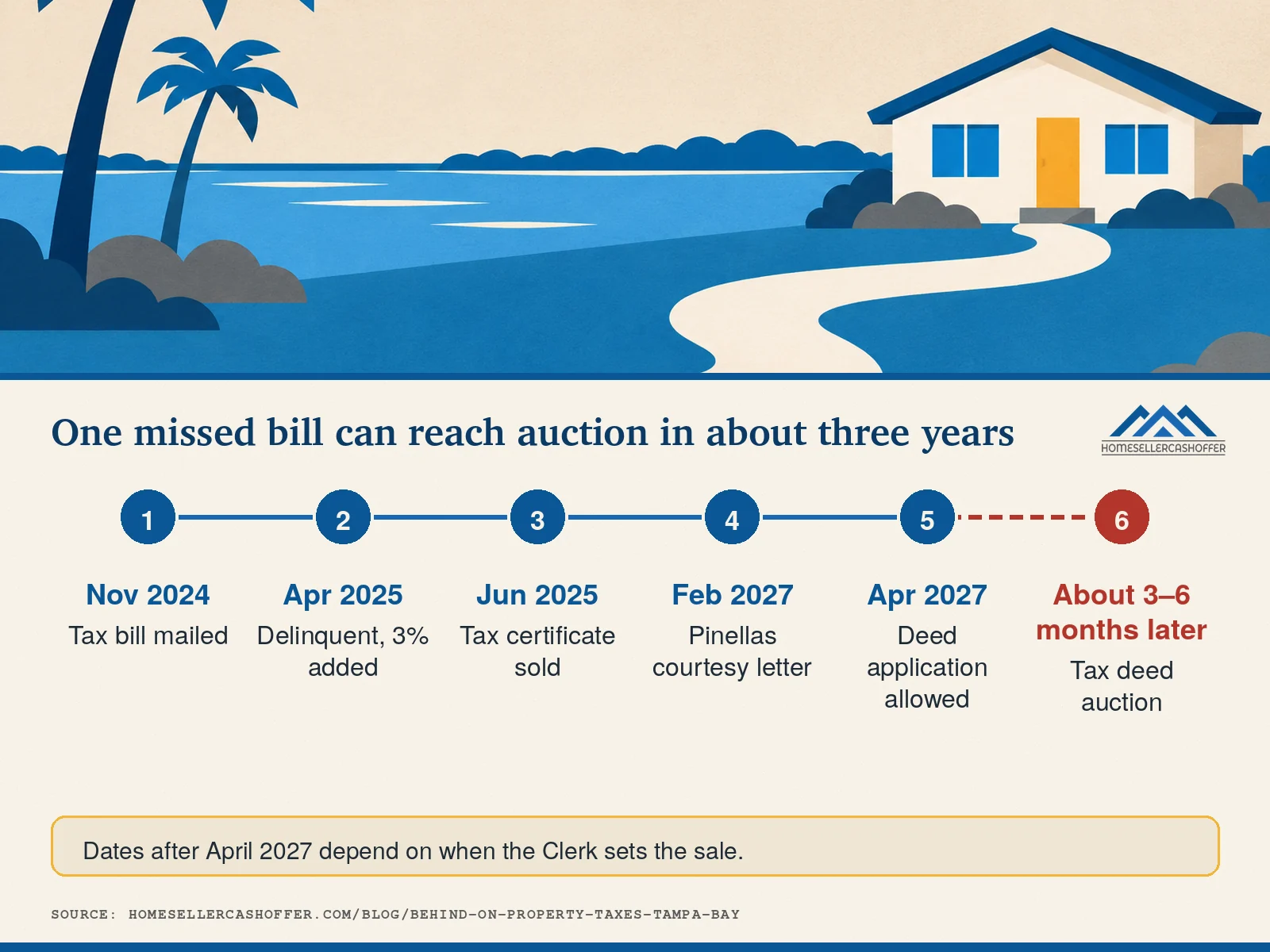
Everything before the deed application is quiet; everything after it moves in months, not years.
How to find out exactly where you stand
The envelope tells you which stage you are in. Sort yours into one of three piles:
- A delinquent notice or a courtesy letter from the Tax Collector. You are between April 1 and the deed application. You have time, and the number is still small.
- A certified letter titled Notice of Application for Tax Deed from the Clerk of the Circuit Court. A sale date exists or is about to. Count the months, not the years.
- Letters from investors, law firms, or "we buy houses" companies. These are not scams, and they are not the county. They mean your parcel is on a public list that others are reading. Open them for the dates; decide on the offers separately.
Then get the real number, because it changes daily. The redemption amount is not on any website; you request a payoff from the Tax Collector, good through the date you plan to pay. Have your parcel ID (on the tax bill or the Property Appraiser's site), the address, and the name on title.
| What you need | Pinellas | Hillsborough |
|---|---|---|
| Tax account and what is owed | pinellas.floridatax.us | county-taxes.net/hillsborough |
| Tax Collector, delinquent taxes | 727-464-3409 | hillstaxfl.gov |
| Scheduled tax deed sales (Clerk) | pinellas.realtaxdeed.com | hillsborough.realtaxdeed.com |
Ask for the payoff itemized. It will include every outstanding certificate, the interest on each, any current-year taxes that came due during the process, the Clerk's fees and title search, and, once an application is filed, the applicant's costs plus 1.5% a month. You are entitled to see each line.
The ways out, from cheapest to most drastic
There is no negotiating with a tax certificate. The county cannot discount it, the investor is owed by statute, and partial payments on delinquent taxes are not accepted in either county. Every path below ends with the full payoff reaching the Tax Collector; they differ only in where the money comes from and what you keep.
1. Pay it off. If you have the money, this is the cheapest answer by a wide margin and you do not need anyone's help to do it. Get the payoff, pay in certified funds, cash, or wire to the Tax Collector (not the Clerk, not the law firm), keep the receipt, and confirm with the Clerk that the sale came off the calendar. If a sale date is set, pay at least two business days early; a wire sent the morning of the auction may not credit in time.
2. Borrow against the house. A home-equity line, a cash-out refinance, or a family loan can cover a payoff when equity is there. The catch is time: a lender needs weeks to close, and a lender will not fund against a house with a sale date next Thursday. This works in the quiet two years, rarely in the last six months.
3. Stop the next one from happening. Neither of these erases a certificate that already exists, but both keep the pile from growing. The quarterly installment plan splits next year's bill into four payments; apply to the Tax Collector by April 30. The homestead tax deferral (section 197.252) lets income-qualified homestead owners defer current taxes as a low-interest lien; apply by March 31 each year. Both counties also accept partial payments on current taxes between November and March, before they go delinquent.
4. Bankruptcy. A filing creates an automatic stay that can pause a scheduled tax deed sale, and a Chapter 13 plan can spread the tax debt over years. It does not erase the debt, it affects everything else you owe, and it is a decision for a bankruptcy attorney, not a blog post.
5. Sell before the sale. A sale is the one path where the money comes from the house rather than from you. With months of runway, a conventional listing can work; with weeks, you need a buyer who can pay the taxes directly to the Tax Collector before the sale date and close on the rest. The next section covers how that works.
6. Let it sell and claim the surplus. The worst option for anyone with equity. On a homestead the opening bid includes half the assessed value, so the sale price can exceed the debt, but the surplus does not come to you automatically. The Clerk pays government liens first, then mortgage and lien holders who file within 120 days, and the former owner last, only by notarized claim. Unclaimed money goes to the State.
Selling the house when the auction is close
A signed purchase contract does not stop a tax deed sale. Only cleared funds at the Tax Collector do. That one fact decides what a sale has to look like when the date is near.
A conventional listing runs on its own clock: showings, an inspection, a buyer's financing, a 30- to 45-day close. If the sale date is four or five months out and the house shows well, that clock can fit, and you should ask a local agent what the net would be. If the date is six weeks out, it usually cannot, and the risk is that the auction happens while you are under contract.
The alternative is a direct sale to a buyer who treats the tax payoff as step one rather than a closing-day line item. This is how we handle it at HomeSellerCashOffer:
- We pull the Clerk's case file and request the itemized payoff from the Tax Collector, and we show you both.
- Once we have an agreement, we pay the redemption directly to the Tax Collector, in certified funds or by wire, before the sale date. That cancels the case; the certificate holder is paid off and the house stays in your name.
- Then we close on the house, typically 7 to 21 days later, through a title company. We pay the closing costs. The taxes we advanced come off the price at closing, so you never come out of pocket to stop the clock.
Two things we say to everyone in this position. First, if you can redeem on your own, do that; we will tell you so, and we have. Second, ask any buyer, including us, exactly when and how the redemption gets paid, and get it in writing. "You're under contract, so you're safe" is wrong, and it has cost people their houses.
The same approach works for an inherited property still in probate, a rental that got away from you, or a house with several years of stacked certificates. The number is the number; the question is whether paying it leaves you with more than selling does, and that is a comparison you can make with both figures in front of you.
What to do this week
- Open every envelope and write down two dates: when the taxes went delinquent and, if there is one, the sale date.
- Look up the parcel on the county tax site and count the certificates against it.
- Call the Tax Collector for an itemized payoff good through a date two weeks out.
- If a sale date is set, check the Clerk's auction site and confirm the case number matches your letter.
- Decide which of the six paths fits the number, and if it is a sale, get the buyer's tax-payment step in writing.
The tax deed sale is the last stage, not the first. Everyone who reads this before the auction date still has a move. If you want a second set of eyes on the payoff and the Clerk's file, send us the parcel number or address and we will walk through it with you, including "just redeem it" if that is the answer.
Common questions
How long can I go without paying property taxes in Florida before I lose the house?
A certificate is sold the June after the April 1 delinquency, the holder can apply for a tax deed two years after that April 1, and the auction follows three to six months later. The earliest realistic loss is about two and a half years after the first missed bill.
Does a homestead exemption stop a tax deed sale?
No. It adds half the assessed value to the opening bid, which protects some equity in the surplus, but homesteaded houses sell at these auctions every month.
Can I pay off just the oldest year to stop the sale?
No. Once an application is filed, the payoff includes every certificate on the house plus the applicant's costs. One year does not clear the file.
Can someone other than the owner pay it off?
Yes. Florida law lets any person redeem a certificate before the deed issues, which is how heirs, lienholders, and buyers stop sales.
Sources
- Pinellas County Tax Collector, Tax Certificate & Tax Deed (delinquency, 3% interest, courtesy letters, 3 to 6 months to auction, stopping the sale)
- Hillsborough County Tax Collector, Delinquent Property Tax (certificate sale on the last Saturday of May, no partial payments, redemption before auction, bankruptcy)
- Hillsborough County Tax Collector, Tax Deeds (two-year rule, seven-year certificate life, interest on the application amount)
- Hillsborough County Tax Collector, Payment Plans (installment plan by April 30, partial payments on current taxes, homestead deferral)
- Hillsborough County Clerk, Tax Deed Sales (Thursdays at 10:00 a.m., online)
- Florida Statutes 197.502, Application for tax deed; opening bid and Fla. Admin. Code 12D-13.063 (homestead half-value add-on)
- Read on October 31, 2026.
Not sure where your case is?
Send the parcel number or address and we’ll look at the payoff and the Clerk’s file with you — including “just redeem it” if that’s the answer.
Have a specific situation? Reach outThis article is general education about Florida tax delinquency in Pinellas and Hillsborough counties. It is not legal or tax advice. For the exact payoff on a parcel, call the Tax Collector; for advice on your situation, consult a Florida attorney.
Where we buy houses
We buy houses for cash across Tampa Bay: St. Petersburg, Tampa, Clearwater, Largo, Pinellas Park, Brandon and Pasco County.

AL Cakici · Owner, HomeSellerCashOffer (Tampete Homes LLC)
AL is the owner and manager of Tampete Homes LLC (Florida LLC L25000252906, d/b/a HomeSellerCashOffer) and buys houses in Pinellas, Hillsborough and Pasco, many with its own cash. He has personally purchased and assisted with 100+ real estate transactions over 10+ years across the country. He is not an attorney or a real estate agent; this article is general information drawn from the official sources listed on this page, not legal advice. Facts checked against those sources on October 31, 2026.